The Ultimate Guide to Talent Buying Services: How to Book National Acts & Maximize Event ROI
Securing live entertainment for a festival, corporate gala, venue, or tribal casino can transform a standard gathering into a marquee destination event. Yet, navigating the live music industry remains notoriously complex. Between managing unwritten talent agency protocols, interpreting multi-page technical riders, and negotiating performance contracts, event organizers face high financial stakes with narrow margins for error.
Without an insider’s understanding of roster availability and realistic market rates, buyers risk overpaying for talent, signing restrictive exclusivity clauses, or failing to meet technical production requirements on show day.
That is where professional talent buying services come in. Working with experienced buyers bridges the gap between event organizers and middle-agent talent agencies, ensuring event vision aligns perfectly with fiscal reality.
What Are Talent Buying Services?
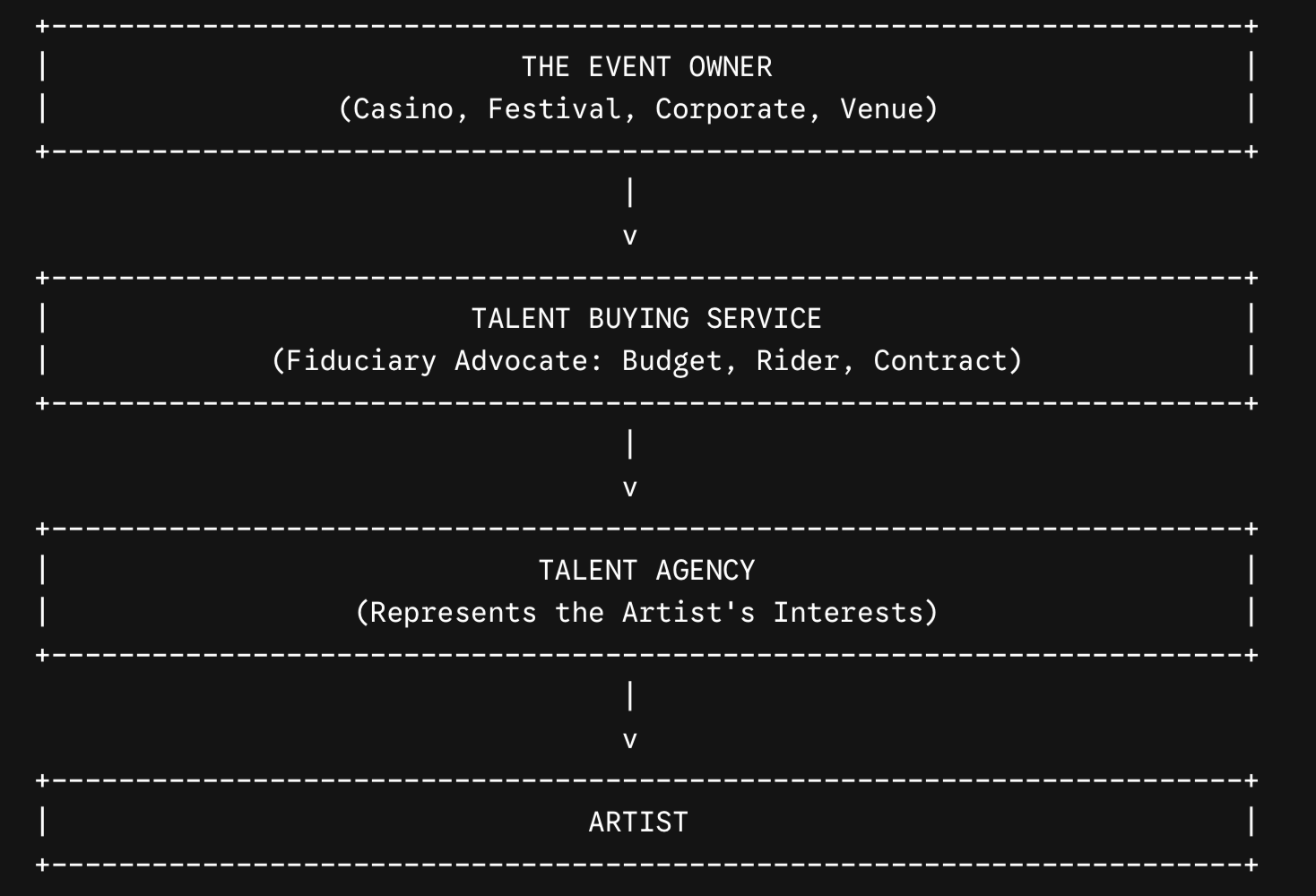
Talent buying services provide expert procurement, negotiation, and production oversight for live entertainment. A professional talent buyer acts as an exclusive advocate for event organizers and venue owners, leveraging industry relationships and historical data to secure national touring artists, negotiate competitive performance fees, handle contract riders, and minimize overall financial risk.
What Are Talent Buying Services?
At its core, talent buying is the strategic process of sourcing, negotiating, and securing live entertainment for specific venues, festivals, corporate gatherings, or private events.
A talent buyer serves as the strategic advisor and negotiator for the venue or talent-purchasing entity. Rather than acting as a neutral intermediary, a dedicated talent buyer sits on your side of the table.
Core Responsibilities of a Talent Buyer
-
Roster & Calendar Curation: Aligning artist availability with your event dates, demographic target, and thematic goals.
-
Fee Negotiation: Leveraging historical pricing data and route-mapping knowledge to secure fair market rates.
-
Contract & Rider Vetting: Reviewing legal contracts, hospitality requirements, and technical rider specifications.
-
On-Site Production Oversight: Ensuring stage managers, sound engineers, and hospitality teams fulfill contractual obligations smoothly.
Talent Buyer vs. Booking Agent: The Critical Difference
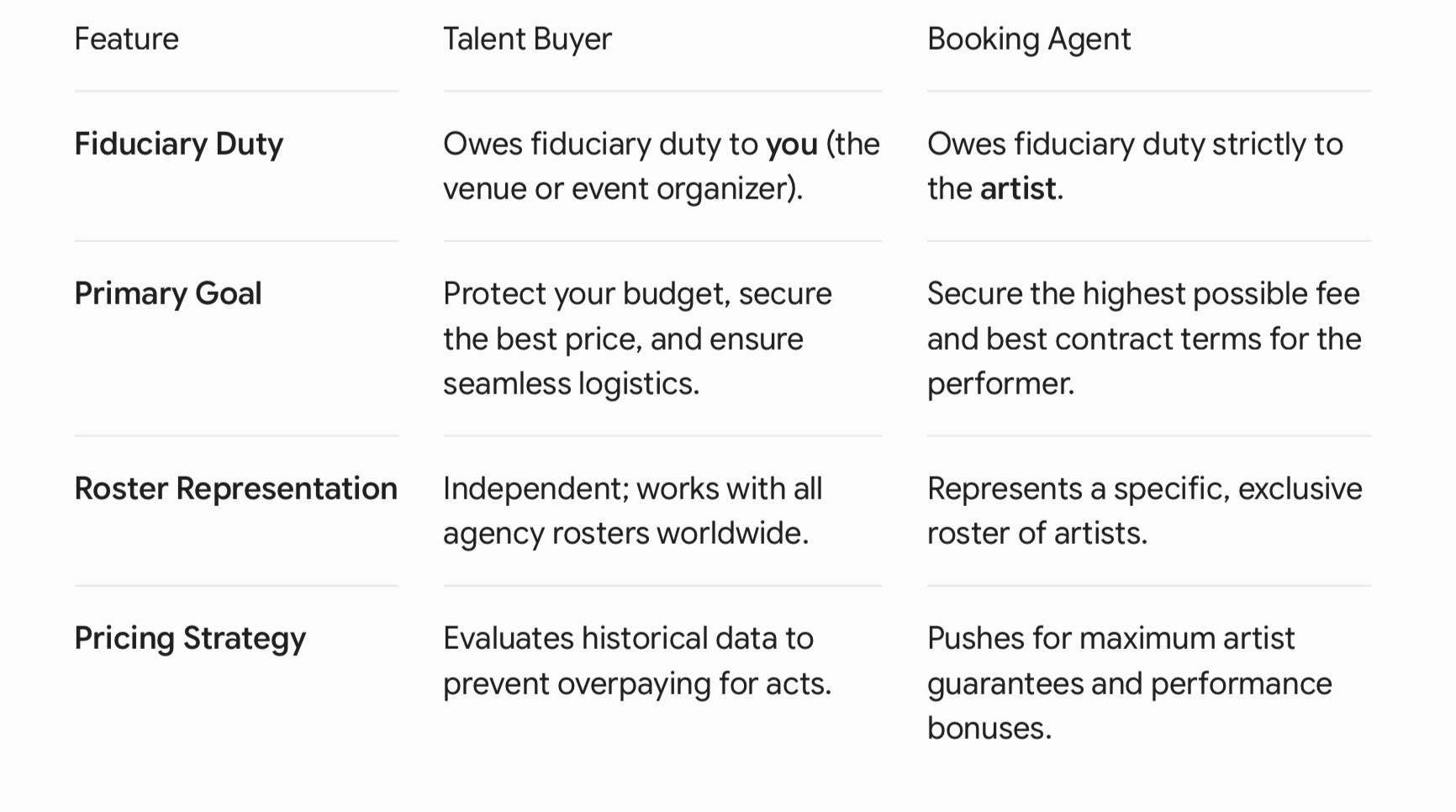
A common point of confusion for event organizers is the distinction between a talent buyer and a booking agent. Conflating these two roles can lead to misaligned incentives and inflated event costs.
The Step-by-Step Talent Buying Process
Securing a national headliner involves a standardized industry workflow. Missing a single step in this sequence can derail negotiations or lead to forfeited deposits.
1. Discovery, Routing, and Budget Analysis
Before contacting agencies, we analyze demographic preferences, local market competition, and total talent allocation. Talent costs extend well beyond the artist’s headline performance fee. A safe rule of thumb: reserve 25% to 35% of your total entertainment budget for secondary costs (production, backline, travel, accommodations, and catering).
2. Drafting and Submitting the Formal Offer Form
In the professional entertainment space, casual emails or telephone calls do not hold calendar dates. Booking agencies require a standardized Formal Offer Form. Once submitted, a formal offer acts as a binding intent to contract.
Key elements of a binding offer include:
-
Guaranteed Performance Fee: The fixed compensation offered to the artist.
-
Deposit Schedule: Typically 50% upon contract execution, with the remaining 50% paid via cashier’s check or wire transfer on the day of the show.
-
Venue Capacity & Ticket Scale: Complete layout details, including gross potential revenue and ticket price tiers.
-
Radius Clause Terms: Specific geographical restrictions preventing the artist from playing competing local venues within a set timeframe.
3. Contract Execution and Rider Auditing
Once an offer is accepted, the talent agency issues an artist agreement accompanied by legal and technical riders.
4. Advance Logistics and Day-of Show Management
In the weeks leading up to the performance, advance management begins: coordinating ground transportation, booking hotel room blocks, securing local backline gear, acquiring permits, and organizing sound checks.
The Technical Rider
The technical rider outlines exact gear needed for the performance:
-
Front of House (FOH) Sound: Specific digital mixing consoles and PA system output parameters.
-
Monitors & In-Ear Systems: Wireless frequency coordination requirements.
-
Lighting Rig: Intelligent fixture layouts and stage wash dimensions.
-
Backline Equipment: Precise vintage guitar amplifiers, specific drum kit configurations, or grand pianos.
Expert Warning: Never sign a technical rider without consulting your production lead or an experienced buyer. Agreeing to unsupported technical specs can result in tens of thousands of dollars in emergency rental fees on show day.
The Hospitality Rider
Hospitality riders detail artist comfort preferences: required hot meals, specific dietary accommodations, dressing room setups, and hotel room requirements (often specifying 4-star or 5-star properties).
Industry Insights: Casino, Corporate, and Festival Buying
Different venue models require tailored entertainment strategies.
Tribal & Commercial Casino Entertainment
Casinos use live entertainment to drive up gaming floor and hotel occupancy when it is their off season. Casinos also just want to provide a good act for their customers.
-
Key Objective: Attract high-earning demographics during non-peak hours.
-
Strategic Buying: Booking legacy acts, nostalgia tours, and high-energy tribute acts yields strong gaming returns compared to high-risk indie acts. Evaluating casino entertainment booking strategies ensures programming aligns with player loyalty tiers.
Myth vs. Fact in Talent Procurement
-
Myth: Reaching out directly to an artist’s agent gets you the cheapest rate.
Fact: Agents represent artists, not buyers. They pricing-test unrepresented buyers, often quoting inflated rate cards to gauge budget elasticity.
-
Myth: Once the performance contract is signed, the talent buyer’s work is finished.
Fact: Over half of all event work happens after contract execution during production advancing, technical sourcing, and day-of-show management.
-
Myth: A technical rider is just a list of general recommendations.
Fact: Riders are legally binding contract addendums. Failing to provide requested gear can cause act cancellations with full fee forfeitures.
How Professional Buyers Like SEG Protect Your Bottom Line
When you hire experienced buyers, you gain dedicated advocacy across every phase of event planning.
-
Leveraging Middle-Agent Relationships: Professional buyers maintain daily conversations with agency desks, instantly identifying acts actively routing through your region. Sourcing an act already on the road saves thousands in dedicated fly-in and freight costs.
-
Rider Trimming: Talent buyers routinely review and line-item-vet riders, removing unnecessary hospitality requests and adjusting technical specifications to match available local inventory.
-
Contract Protection Clauses: Experienced buyers add protective language covering force majeure, severe weather contingencies, deposit return schedules, and performance timing guarantees.
Frequently Asked Questions (FAQ)
What is the typical fee structure for talent buying services?
Talent buying services operate either on a flat fee per booked event, a percentage of the total talent cost (typically 5% to 15%), or a monthly retainer for continuous venue programming.
How far in advance should we start booking national headliners?
For major national touring acts and headline talent, begin negotiations 6 to 12 months before your event date. Regional acts and local support talent can typically be secured 2 to 4 months in advance.
What is a radius clause in a talent contract?
A radius clause prevents an artist from performing within a specified geographical distance (e.g., 50 to 100 miles) for a set period before and after your event date. This protects your local ticket sales and event exclusivity.
What happens if an artist cancels due to illness or weather?
Standard contracts include Force Majeure clauses. If an artist cancels due to covered unforeseen circumstances, your deposit is returned. Professional talent buyers often secure cancellation insurance or quickly source replacement talent.
What is “backline,” and who pays for it?
Backline refers to the musical instruments and stage equipment required by the performer (amplifiers, drum kits, keyboards, wireless systems). The event organizer provides and pays for backline equipment as outlined in the technical rider.
Can a talent buyer help with production and staging?
Yes. Complete talent buying services assist with production advancing, stage lighting, sound system rentals, backline procurement, and on-site stage management.
Conclusion & Next Steps
Successful talent buying requires a balance of creative vision, market data, and precise legal execution. Securing the right act at the right price builds your event’s long-term reputation and brand equity.
Actionable Next Steps
-
Define Your Target Demographic: Tailor artist choices to your audience’s clear music preferences.
-
Establish a Complete Line-Item Budget: Account for venue rentals, technical production, hospitality, and insurance alongside artist fees.
-
Audit Local Market Schedules: Check regional calendar dates to prevent direct competition with similar local events.
-
Work with Experienced Advocates: Engage professional talent procurement teams early to negotiate terms and protect your financial investments.
If you are planning a live event, casino entertainment season, festival, or corporate gala and want to streamline your talent procurement, reach out to our team at Seattle Entertainment Group to discuss your upcoming event goals.